


Despite EU restrictions on exporting radio navigation equipment to Belarus and Russia, GPS trackers made by Lithuanian company Teltonika continue to reach both markets. BIC traced one supply route: until at least February 2025, Belarusian company BelTransSputnik purchased Teltonika trackers from Russian firm Laboratoriya Interneta Veshchei, which received Teltonika-branded electronics from Hong Kong-based Sinalex in September 2023.
At the same time, BelTransSputnik supplied Teltonika devices back to Russia. From March 2023 to March 2025, it sold 345 GPS controllers and vehicle trackers worth more than $100,000 to Smolensk-based Evrosvyaz. Some models were sold to Russia for roughly twice the price BelTransSputnik had paid for the similar devices there shortly before.
Teltonika products are also offered by Belarusian company Vissen. In 2022—2023, it imported approximately 1,770 trackers manufactured by Teltonika Telematics and obtained Belarusian declarations of conformity for them. In 2023, the State Authority for Military Industry of Belarus registered four Teltonika models as navigation resources, listing Vissen as the resource owner. Vissen continued to describe itself as a Teltonika partner, although Teltonika Group told BIC that its official partner status had expired in December 2020.
Teltonika Group said it has not sold to or knowingly supplied customers, distributors or resellers in Belarus or Russia since 2022 and has not authorized third parties to resell or distribute its products there.
From January 2022 through June 2025, Belarusian companies shipped more than $400,000 worth of Western-made GPS and navigation equipment to Russia. Not all of these shipments necessarily indicate sanctions evasion, as restrictions were introduced at different times and covered different categories of equipment.
Despite EU restrictions on exporting radio navigation equipment to Belarus and Russia, products from Western brands still reach these markets. BIC traced one such supply route using GPS trackers made by Lithuanian company Teltonika as a case study. Equipment from this manufacturer was supplied to a Belarusian company by a Russian company that sourced the products, in part, through a third country. At the same time, the Belarusian company continued selling Teltonika trackers to a buyer in Russia.
This investigation was conducted with the assistance of the Rabochy Ruch initiative and in partnership with the Siena Center for Investigative Journalism.
Teltonika leaves, but the electronics remain
“We work with Teltonika [products]. We do have Teltonika,” said an employee of BelTransSputnik, a Belarusian company that describes itself as an IT company specializing in transportation management. A BIC journalist spoke with him, posing as a potential buyer.
The Teltonika Group, a Lithuanian technology giant, manufactures GPS trackers, sensors, and other transportation monitoring systems. In August 2023, the EU banned the export of radio navigation aid apparatus to Belarus “in view of the situation in Belarus and the involvement of Belarus in the Russian aggression against Ukraine.” However, a company employee told a BIC journalist that BelTransSputnik continues to work with Teltonika products. He clarified that they now work with these products only when customers place an order, and in smaller volumes than before.
“Teltonika is the equipment we typically install on tractor units when they’re used for international transport, and the customer needs to connect it to the tachograph [a device that records the vehicle’s speed, mileage, driver’s working hours, and other data — ed. note].”
BelTransSputnik holds a Belarusian declaration of conformity for Teltonika FMC series vehicle trackers, which are capable of operating on 4G networks. The declaration is valid from 2025 to 2030. This is despite Teltonika’s announcement of its withdrawal from the Belarusian and Russian markets following the outbreak of full-scale war in Ukraine. In an interview with the Lithuanian television company LRT, the brand’s founder, Arvydas Paukštys, said that the company severed ties with customers in those countries and introduced technological restrictions into new models so that they could not operate within their territories. However, during a conversation with a BIC journalist, the BelTransSputnik employee said that the company has no difficulty servicing the equipment in Belarus.
“The problem with Teltonika in Belarus isn’t servicing it — we can and do service it. Most of [our] clients use it. The problem is getting supplies.”
Apparently, BelTransSputnik is resolving its supply issues by no longer buying goods directly from the European neighbours. Until at least February 2025, the company’s trackers were supplied by the Russian firm Laboratoriya Interneta Veshchei. In September 2023, that company received Teltonika-branded electronics from Sinalex, a Hong Kong-based company.
Sinalex was previously mentioned in an investigation by Lithuanian television broadcaster LRT regarding the shipment of Teltonika products to Russia. Journalists named the Turkish companies Aavat Endustri̇yel Si̇stemleri̇ and Olimpik Gama Logistics, among other suppliers. However, in a comment to LRT, the manufacturer did not rule out the possibility of illegal use of its brand on products manufactured by other companies.
A return trip to Russia
BelTransSputnik not only purchases Teltonika-branded equipment in Russia but also supplies the brand’s devices to the Russian market itself. From March 2023 to March 2025, the Belarusian company sold a total of 345 Teltonika GPS controllers and vehicle trackers for a total of more than $100,000. All shipments were received by Evrosvyaz, a Smolensk-based company with two employees.
At the same time, the price at which BelTransSputnik supplied some equipment models to Russia may have been roughly twice the cost of purchasing the same models in Russia. For instance, in March 2025, Evrosvyaz spent $17,677 on 45 Teltonika FMC650 trackers, amounting to about $393 per device. The previous month, BelTransSputnik purchased the same model of tracker for $186 each. A year and a half later, devices of this model can be purchased for about $145 each on European marketplaces. [*] [*]
This trade is taking place amid sanctions that target not only Belarus. Following the outbreak of a full-scale war in Ukraine, the European Union banned the export of radio navigation equipment to Russia, which is often essential for logistics. Similar restrictions were introduced by the United States and the United Kingdom in 2024.
Frederic Bruneteau, managing director of the Ptolemus consulting group, which specializes in telematics technologies, told the BIC that the reason GPS trackers and radio navigation equipment in general ended up on sanctions lists may be their potential for military use.
“[A GPS device] is [suitable] for any moving vehicle, or you can even put that in a handbag. It’s basically used to position anything: it can be a container, it can be a truck, it can be a car, it can be a tank, it can be a bicycle. It can be used anywhere. Of course, you could use it in a drone.”
Before and after the call with the BIC
BelTransSputnik is not the only company that sells Teltonika products in Belarus. Vissen, a small company that specializes in transport monitoring and equipping vehicles with electronic modules, also offers the brand’s equipment.
In early August this year, Vissen described itself on its website as an official Gold Partner of Teltonika Telematics, one of the companies in the Teltonika Group. After sending a press inquiry to the company, we noticed that the description had changed. A clarification stating that Vissen had been a partner of the Lithuanian company only until the end of 2022 appeared on the page. According to the current website description, this allows Vissen tosale and installation of Teltonika navigation terminals, as well as their configuration, diagnosis, and warranty and post-warranty repair.
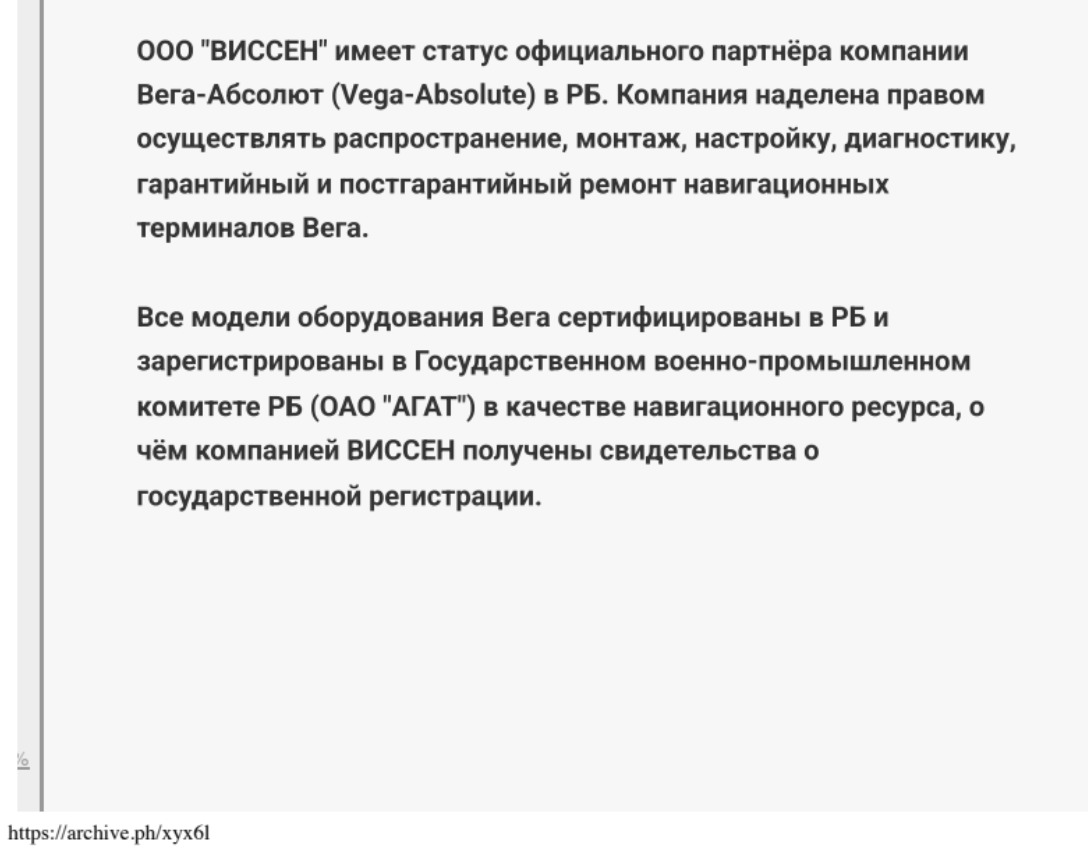
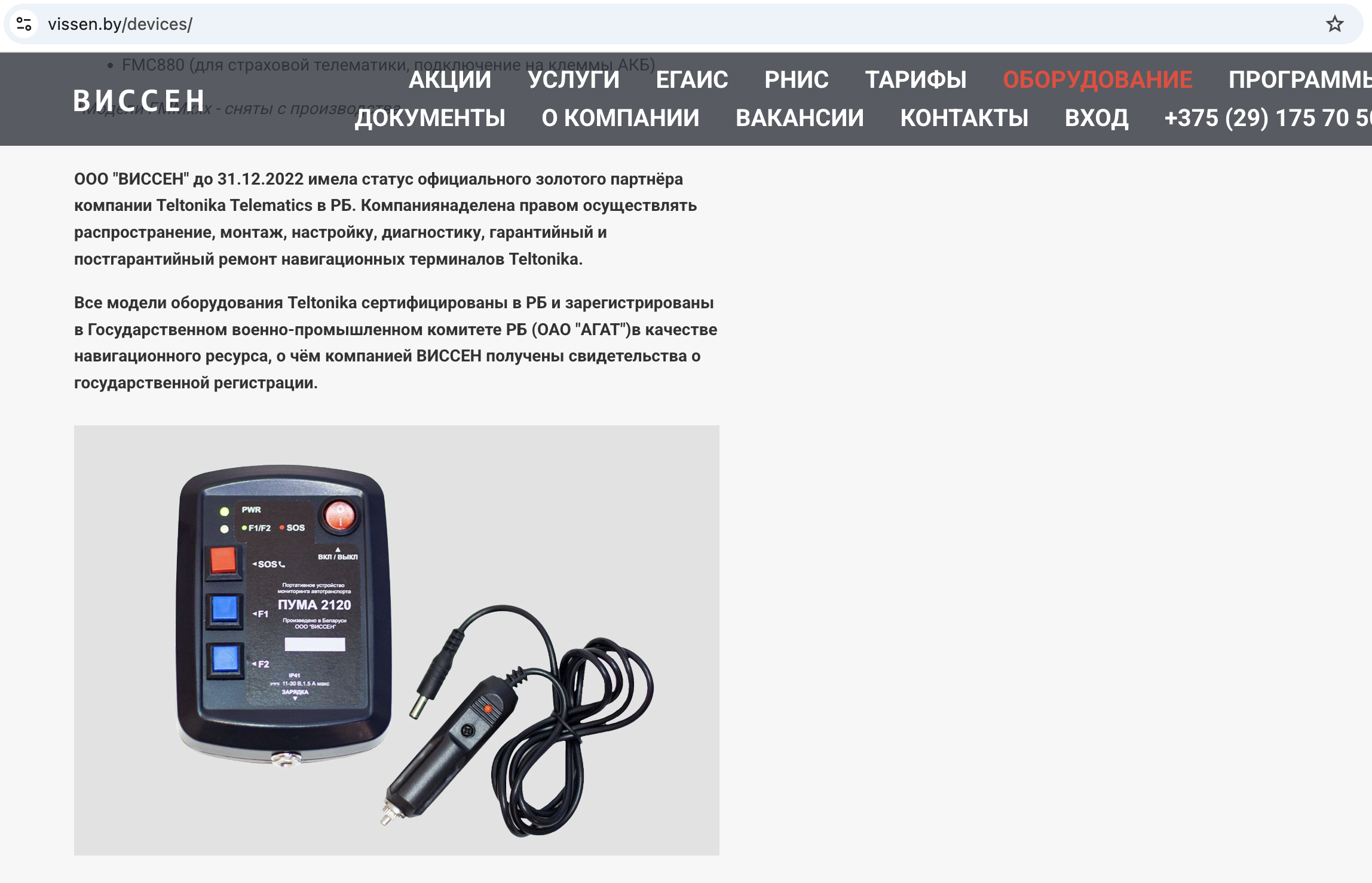
In response to BIC’s inquiry, Teltonika Group noted that Vissen held the status of an official gold partner until December 2020, not 2022, as stated on the Belarusian company's website. The organisation also stressed in its response that it maintains “a strict, principled position when it comes to working with countries subject to sanctions.”
Teltonika Group's full response to the BIC inquiry
Thank you for your questions. We are responding on the record, as requested, and note that our comments below apply to all of the numbered questions in your message.
In 2022, in support of Ukraine, Teltonika IoT Group publicly announced the suspension of sales to, and closure of offices in, Russia and Belarus. That suspension remains in place. We do not sell to, market to, or knowingly supply customers, distributors, or resellers in Russia or Belarus, and we have not approved, authorized, or otherwise supported any sale, resale, or distribution of our products into either country by any third party, including the companies you name.
We maintain a strict, principled position when it comes to working with countries subject to sanctions. We have allocated more than 3 million euros in support of Ukraine in its fight against Russia, and we continue to operate an office in Kyiv. We are grateful to our colleagues there for their determination to keep working even under wartime conditions.
On the specific claim that "Vissen" LLC describes itself as our "official golden partner": we have reviewed the document referenced on their website and it expired in December 2020, before our 2022 suspension of sales to Belarus and Russia. Any partner status "Vissen" LLC may be relying on is therefore lapsed and no longer valid, and does not reflect any current or authorized relationship with Teltonika. We would ask that this outdated and expired document not be presented as evidence of a current partnership, as doing so would be materially misleading.
Given that this specific claim rests on an expired, five-year-old document, we are concerned that other assumptions in your questions may similarly rely on information that has not been fully verified. For that reason, and because we have no knowledge of the specific transactions, import records, or certifications referenced in your other questions, including those attributed to PUE "BelTransSputnik" or the Turkish and Chinese entities you mention, we are not in a position to confirm, deny, or otherwise comment on the accuracy of third-party records, statements, or claims that we have not seen and had no part in.
Teltonika has invested in research and development to create technological solutions that either prevent its products from being used in Russia or Belarus or significantly limit their functionality within the countries. We continue to review and strengthen our compliance controls, including distributor due diligence and contractual restrictions on resale into sanctioned markets, and we take any credible, specific evidence of circumvention seriously. We would welcome any documentation you are able to share that would allow us to investigate the specific transactions referenced in your questions.
We would appreciate it if any published piece reflects this response in full and takes into account that the "golden partner" document you intend to rely on is expired and outdated.
At the same time, we found evidence suggesting that Vissen continued to work with Teltonika products after 2022. The Belarusian company’s website still showcases the brand’s equipment. In September 2023, the State Authority for Military Industry of Belarus registered four Teltonika GPS tracker models as navigation resources. The registration documents list Vissen as the resource owner and Teltonika Telematics as the device manufacturer.
According to the company’s import data, Vissen imported approximately 1,770 trackers manufactured by Teltonika Telematics into Belarus in 2022–2023. The company obtained Belarusian declarations of conformity for these devices. The BIC was unable to determine where exactly the equipment had been supplied to Belarus from.
Information regarding the organizations referenced in the investigation
In this article, Teltonika Group refers to UAB Teltonika IoT Group registered in Lithuania (identification number: 124429895).
In this article, Teltonika Telematics refers to UAB Teltonika Telematics registered in Lithuania (identification number: 305578349).
In this article, BelTransSputnik refers to PUE BelTransSputnik (PUP Beltranssputnik) registered in Belarus (identification number: 190604746).
In this article, Vissen refers to TAA Vissen registered in Belarus (identification number: 193339631).
In this article, Laboratoriya Interneta Veshchei refers to OOO Laboratoriya Interneta Veshchei (formerly OOO Ivan Glonassov EKSP) registered in Russia (identification number: 7804605305).
In this article, Sinalex refers to Sinalex Limited registered in China (Hong Kong).
In this article, Aavat Endustriyel Sistemleri refers to Avat Endustriyel Sistemleri Ic Ve Dis Ticaret Limited Sirketi (Avat Endüstri̇yel Si̇stemleri̇ İç Ve Diş Ti̇caret Li̇mi̇ted Şi̇rketi̇) registered in Türkiye (identification number: 394880-5).
In this article, Olimpik Gama Logistics refers to Olimpik Gama Ic Ve Dis Ticaret Sanayi Limited Sirketi (Oli̇mpi̇k Gama İç Ve Diş Ti̇caret Sanayi̇ Li̇mi̇ted Şi̇rketi̇) registered in Türkiye (identification number: 693447-0).
In this article, Evrosvyaz refers to OOO Evrosvyaz registered in Russia (identification number: 6729024160)
Trading despite the ban
Belarus and Russia could replace European trackers with Russian or Chinese analogs, but it is important to consider whether such alternatives are compatible with thesoftware used by a particular company. Anton Tananaev, the lead developer of the Traccar GPS tracking platform, told BIC that although most platforms support devices from Russia and China, Teltonika electronics have their own advantages.
“Teltonika devices are generally considered more reliable. In terms of capabilities, comparable substitutes do exist, but they won’t be as cheap. Very low-cost Chinese devices are usually quite limited in functionality and definitely less reliable.”
Teltonika product shipments are part of the larger flow of Western radio navigation electronics being sent from Belarus to Russia. According to our data, from January 2022 through June 2025, Belarusian companies shipped over $400,000 worth of Western-made GPS controllers, trackers, navigation systems, and other equipment to Russia. These included both new and used goods. These shipments do not all necessarily indicate sanctions evasion. Bans imposed by different countries were introduced at different times and applied to different categories of equipment.
The BIC sent inquiries to BelTransSputnik, Vissen, Sinalex, and the Teltonika Group, as well as to the heads of Laboratoriya Interneta Veshchei and Evrosvyaz. At the time of publication, we had not yet received any responses.




![[*]](/storage/page_blocks/August2026/17.png)
![[*]](/storage/page_blocks/August2026/215.png)