
Context: In September 2026, the Alternative for Germany party won elections in Mecklenburg-West Pomerania and Saxony-Anhalt. In the latter state, the party received nearly 44% of the vote, yet it could not form a government because it lacks an absolute majority and other political groups refused to form a coalition with it. On October 14, the state parliament of Saxony-Anhalt adopted a resolution demanding an end to military and financial aid to Ukraine and the lifting of sanctions against Russia. The resolution is nonbinding, and experts believe it will not directly affect Berlin’s policy toward Ukraine.
Speaking on SB TV and Alpha Radio, Vadzim Hihin attributed the AfD’s success to voter fatigue with support for Ukraine. The video was published on October 9, 2026.
“The number one thing they are demanding from the government — which is one of the main reasons for the AfD’s victory — is to stop supporting the corrupt Kyiv regime. ‘We are sick of the beggar Zelenskyy’; that is exactly what they call him. ‘Enough sponsoring these fascists.’ This is the main demand that people, the voters, are putting forward. And why did they so demonstratively raise precisely this issue first? Because it is number one on the political agenda.”
Indeed, residents of eastern Germany are more likely to support cutting aid to Ukraine than those in western Germany. According to a September 2026 survey by the INSA Institute, 50% of respondents in eastern regions wanted to reduce support, compared to 41% in western regions. Among AfD supporters across Germany, that figure was 75%. However, attitudes toward aid to Ukraine and reasons for voting for a particular party are two different matters. INSA Director Hermann Binkert noted that, although Ukraine was an important issue in the election campaign, it was not decisive.
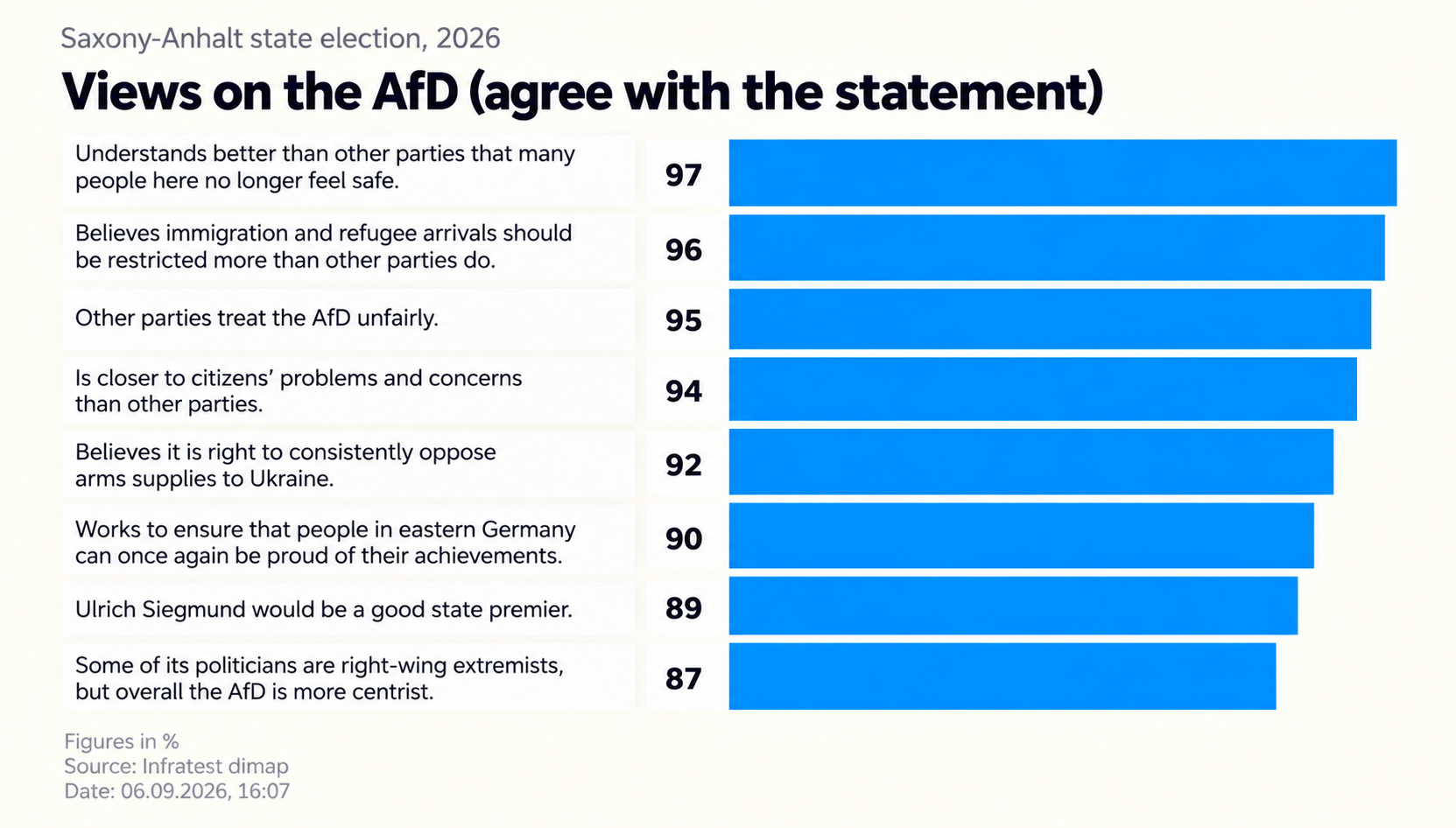
Surveys of AfD voters regarding the reasons for their choice also do not support Hihin’s conclusion. In Saxony-Anhalt, the party supporters most frequently cited domestic security. The next most popular responses were migration, social security, and the economy. “Peace in Europe” ranked below these issues.

In Mecklenburg-West Pomerania, AfD voters also prioritized social security, migration, public safety, and order. Next came the economy and peace in Europe.

Meanwhile, 92% of AfD voters in Saxony-Anhalt supported the party’s stance against delivering arms to Ukraine. While this indicates broad agreement with that specific position, it does not mean that it was the primary motivation for their vote. When asked about their reasons for choosing the party, the topic most closely related to this issue, “peace in Europe,” did not even make it into the top three.