


The Belarusian Investigative Center found that Aliaksei Aleksin, a businessman close to Aleksandr Lukashenko and known as Belarus’s “tobacco king,” may have used offshore companies, a Vanuatu-based bank, and the New Zealand payment platform Worldclear Limited to move and legitimize millions of euros.
The investigation is based on leaked files from Worldclear and Pacific Private Bank, as well as documents from Aleksin-linked companies. According to BIC, from 2016 to 2018, almost $3.5 million was transferred to Aleksin’s personal account at MTBank, which he owned at the time. The money came from the Cypriot company Wallitus Investments Limited and was described as repayment of a $13 million loan allegedly issued by Aleksin. However, journalists found no banking confirmation that Aleksin had actually provided this loan.
At the same time, Wallitus received matching sums from another Cypriot company, Sumsteg International Limited, linked to Aleksin’s long-time partners. Ross Delston, an American anti-money-laundering lawyer, told BIC that the use of multiple offshore companies, banks and jurisdictions resembled “layering” — a method used to obscure the origin of funds.
BIC also found that Sumsteg and other companies linked to Mekhti Mekhtiev, a Russian citizen of Azerbaijani origin, signed oil-product supply contracts with Aleksin family companies worth hundreds of millions of dollars. Most of these contracts were soon terminated. The investigation suggests that the trade may have existed largely on paper: Aleksin’s companies made advance payments, Sumsteg temporarily used the money for short-term loans and earned interest, and matching sums later moved from Sumsteg to Wallitus, which then transferred money to Aleksin's personal MTBank account as loan repayments.
Aleksin, Mekhtiev and several other figures did not respond to BIC’s questions. Lithuanian businessman Vilius Kavaliauskas, formerly linked to Pacific Private Bank and the Lewben/Noewe group, denied involvement in money laundering or other illegal financial activity.
Once upon a time, a Belarusian, a Lithuanian, and a Russian... This is not the opening line of a joke, but rather a story about a scheme showing signs of money laundering and tax evasion The BIC discovered suspicious loans, dozens of terminated contracts, and chains of transfers through related offshore companies and a New Zealand payment platform. At the center of this are Aliaksei Aleksin, a businessman from Aleksandr Lukashenko’s inner circle, and his partners in Lithuania and Russia. They built a complex infrastructure for the withdrawal and legalization of gray incomes through Western jurisdictions, which we exposed.
This investigation was prepared in collaboration with the OCCRP (Organized Crime and Corruption Reporting Project), the New Zealand financial news platform interest.co.nz; Finance Uncovered, an organization that provides financial education to journalists; 15min.lt, a Lithuanian portal; and Expressen, a Swedish newspaper, and the Rabochy Ruch initiative, with the support of CyberPartisans.
What do an American investment fraudster and a Belarusian businessman with ties to Aleksandr Lukashenko have in common? The BIC was able to answer this question thanks to documents provided by its partners, most notably leaked cache of files from the New Zealand–registered company Worldclear Limited (hereafter, Worldclear) and the Vanuatu-based Pacific Private Bank (PPB). [*]
The friend of people with something to hide?
WorldClear Limited helps clients find correspondent banks through which they can transfer funds from one account to another at banks in different countries. Why would they need to do it? Correspondent banks are used if the sending bank doesn’t have any branches in the country where the transfer is being sent. These financial institutions serve as intermediaries, channeling funds through their accounts and enabling their receipt abroad. However, if the correspondent bank deems the payment suspicious — for instance, if the origin of the funds is in question — the funds may be returned to the sender or frozen. Companies like Worldclear Limited identify intermediaries that are most likely to agree to process the transfer. This conclusion can be drawn from one of the company's internal documents.
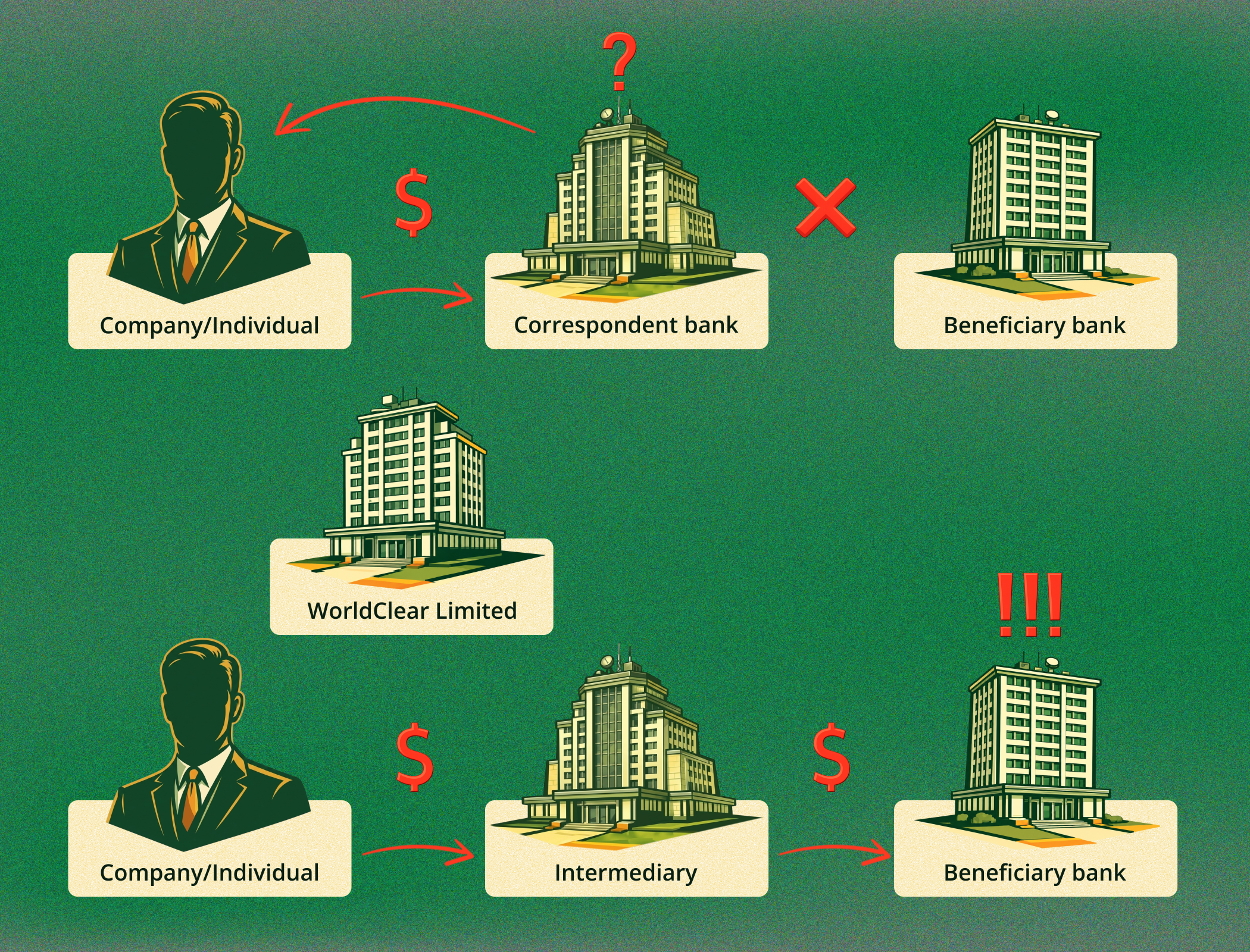
One draft marketing brochure states: “Correspondent banking problems?? USD payment problems?? Closed accounts?? We are here to help you.” It can be inferred that Worldclear targeted clients who had difficulty working with major banks. [*]
This is also supported by testimony that Worldclear founder David Hilary gave to the police in 2018 as part of an investigation involving a former employee. According to Hillary, the company "serves clients that ordinary banks will not take on," and their clients' difficulties are usually "due to their location in the world or their business structure."
According to New Zealand anti-money laundering expert Martin Dilly, transferring funds through payment processors is usually slow and expensive. However, clients may use these firms because they make it harder to trace their cash flows. Ray Blake, a financial crime expert and director of the podcast The Dark Money Files, agrees:
“Complexity is the friend of people with something to hide. It makes it harder for investigators — who might work for the police, the compliance department, the tax authorities, audit bodies or the news media — to untangle the transactions and figure out what has really happened.”
This is confirmed by the names found in the company’s client database. For example, there is West Kingdom Holdings. Journalists discovered that Michael Wilson was its real beneficiary. At the time, Wilson was facing multiple fraud-related charges involving electronic communications. A few weeks after the company became a WorldClear client, Wilson transferred money to a West Kingdom Holdings bank account. Soon after, he chartered a private jet with his wife, mother, and three dogs and fled Canada for Vietnam, where he was arrested and later extradited to the United States.
Michael Wilson was sentenced to nine years in prison in the United States for multimillion-dollar investment fraud.
We have no evidence that Worldclear was aware of Wilson’s fraud or of his connection to West Kingdom Holdings at the time of the transaction. Hillary, the organization’s founder, declined to comment on specific clients or transactions, but he denied any illegal activity. He reiterated that ‘neither he nor WorldClear knowingly or recklessly facilitated any criminal activity.’
His statement is at odds with the findings of a 2018 inspection. At that time, inspectors from New Zealand’s Department of Internal Affairs found that Worldclear only partially complied with the country’s anti-money-laundering requirements and did not always carry out adequate due diligence on its clients. In response to journalists’ inquiries, Hillary acknowledged that the inspection had found that “Worldclear was materially non-compliant with regulatory requirements.” However, he argued that the inspectors’ findings were flawed because they were not grounded in an adequate examination of Worldclear’s records and compliance controls. New Zealand’s Department of Internal Affairs, in turn, rejected Hillary’s criticism as without merit.
Nevertheless, the company avoided penalties — after the violations were uncovered, it was merely issued a compliance order to remedy the breach. Fiona Hall, one of New Zealand’s leading anti-money laundering experts and a lawyer, expressed surprise that WorldClear had not faced stronger action from the authorities.
The art of disguise
The Worldclear file leak contains a list of approximately 200 clients. Of these, the one that interested us the most was Pacific Private Bank Limited (PPB), also known as Pacific Private Bank. It is registered in Vanuatu, an archipelagic country in the middle of the Pacific Ocean between New Zealand, Australia, and Fiji. Vilius Kavaliauskas, a Lithuanian, owned PPB from 2014 to 2018. [*] [*] This businessman and his company, UAB Lewben (which changed its name to Noewe UAB in 2023; hereinafter referred to as Lewben), have appeared in our investigations at least twice: once regarding the smuggling of banned European chocolate, and again regarding the true beneficiaries of large Belarusian casinos. Lewben offers registration, legal support, nominal services, and company administration in tax haven jurisdictions.

A source from the food industry in Belarus claims that it is Teterin’s company BelGlobalGarant that is actually involved in chocolate smuggling.
Upon examining the PPB statements, the BIC investigators discovered numerous transfers totaling millions of dollars in favor of Belarusian businessman Aliaksei Aleksin, who has been involved in many of our investigations. From 2016 to 2018, the funds were transferred to his personal account at the Belarusian bank MTBank, which Aleksin owned at the time. The funds originated from the Cypriot company Wallitus Investments Limited, which Kavaliauskas also owned. The notes on these transfers state that the company repaid the $13 million loan issued by Aleksin in 2015. At the same time, we have no evidence that this loan was actually issued — the leaked files contain information about the loan itself, changes to repayment terms, and transfers of funds for loan repayments, but there is no confirmation of transactions from Aleksin to Wallitus Investments Limited.
Around the same time that Wallitus Investments Limited was sending money to Aleksin, the company was receiving identical amounts from Sumsteg International Limited, registered in Cyprus. These funds were also processed as loan repayments through Kavaliauskas’ bank.
We recounted the scheme to Ross Delston, an American lawyer who has more than 25 years of experience combating money laundering. He explained that this is a classic example of layering:
“Which means using multiple banks and multiple corporations to hide the origin, to hide the source of funds. The second thing that's striking is the offshore financial centres that they use to do this. Cyprus is famous for being hospitable to Russians. <...> Vanuatu, way off in the distance in terms of compliance, is used by everyone”
Tried and trusted partnership
Vilius Kavaliauskas and Aliaksei Aleksin are long-time partners. Over 10 years ago, they were already making money together on what the media called “smuggling.” The Lithuanian company Lewben helped the Belarusian businessman bring 46 million euros to Lithuania from 2014 to 2015.
Aliaksei Aleksin is known in Belarus as the “tobacco king”.
He was sanctioned by the United States and the European Union in the summer of 2021 as Aleksandr Lukashenko’s “wallet.” The businessman’s activities include oil refining, among other things. His family owns SZAO Energo-Oil (SZAT Energa-Oil) and ODO Belneftegaz (TDA Belnaftagaz). Through these companies, Aleksin owned MTB Investments Holdings Limited, a Cyprus-registered company. It almost entirely owns JSC MTBank (ZAT MTBank).A few days before being added to the EU sanctions list, Aleksin transferred ownership of the Cypriot company that controls MTBank to Stoneva Limited, an Emirati company owned by Lebanese businessman Romeo Abdo, who has ties to Belarus. However, the company’s address is listed at the same office as Petrotrade FZE, one of Aleksin’s son Dzmitry’s firms.At the time of publication, the main shareholder of Belarusian MTBank is managed by a company within the Noewe structure (formerly Lewben), [*] which is no longer legally owned by Vilius Kavaliauskas. In 2021, the Lithuanian handed over the reins to his wife, Rita. In 2025, the family reorganized the company and transferred it to trusted managers.However, the Lithuanian’s connection to a Belarusian businessman who is close to the authorities is kept hidden from the public. At first glance, Kavaliauskas appears to be an exemplary citizen. His social media is made up mostly of family photos and art. He presents himself as a patron of contemporary artists. The businessman’s Facebook profile picture features the Ukrainian flag, and he has participated in at least one fundraiser for Ukrainian refugees. Kavaliauskas also reposted messages supporting the independent media in Belarus.
At the same time, his biography is rich in cooperation with another of Aleksandr Lukashenko’s well-known “wallets” besides Aleksin: in 2011-2012, he helped Yury Chyzh earn more than a billion dollars from the resale of contraband Russian petroleum products disguised as solvents and diluents. According to data provided by CyberPartisans, the company co-owned by Kavaliauskas, Charter Jets, presented its business jets for use by Lukashenko’s wife, son, daughter-in-law, and grandchildren, [*] as well as businessman Mikalai Varabei, who is close to Lukashenko. [*]
“Red flags”
While studying the history of multimillion-dollar settlements between Aleksin and offshore companies, BIC journalists noticed several “red flags” — signs of money laundering. The first is the chronology of events. Kavaliauskas acquired the Vanuatu bank in June 2014 and registered the Cyprus company Wallitus Investments Limited in March 2015. [*]
A week later, Aleksin gained control of MTBank. In November of that same year, he allegedly provided a loan to Wallitus Investments Limited, which paid him by transferring funds to his MTBank account after receiving them from Sumsteg International Limited.
The second “red flag” was the use of the New Zealand-based WorldClear system, which made transfers easier and avoided additional scrutiny when Kavaliauskas’s bank moved money to the Belarusian businessman.
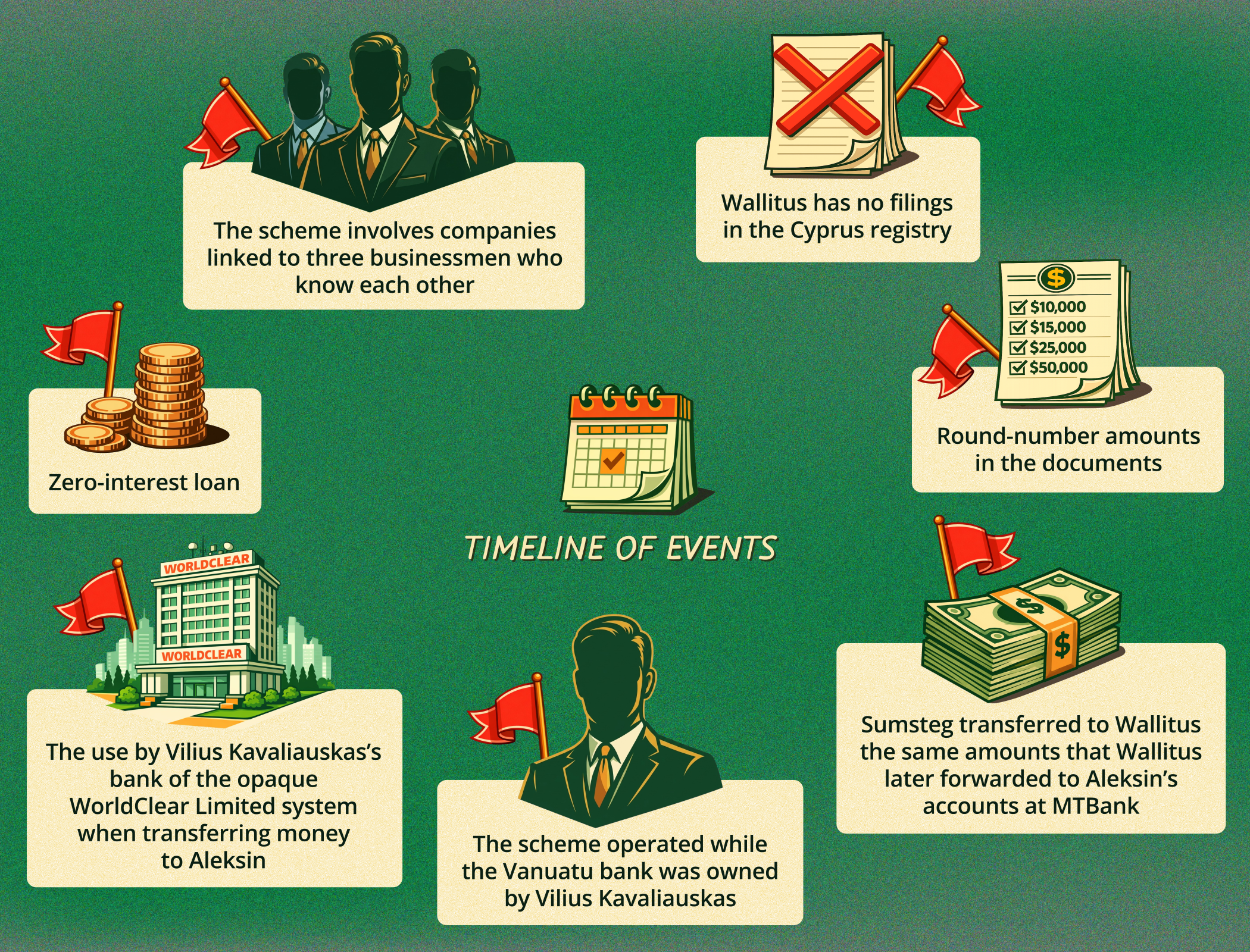
The documents at our disposal show that Aliaksei Aleksin received nearly $3.5 million in his account in this way. Of that amount, $1.1 million and €1.1 million were received through WorldClear, even though he was not a client of the platform himself. We have no proof that Worldclear knew the funds involved in the transactions described above may have originated from criminal activity. We outlined the scheme in detail to David Hillary, but he did not reply to our inquiry.
The scheme worked until the Vanuatu bank’s ownership changed in January 2018. At that point, it was acquired by a company unrelated to Kavaliauskas's Lewben. After the last successful transaction in February, Wallitus Investments Limited had trouble transferring money to Aleksin because correspondent banks started rejecting the transactions. After a few weeks and several unsuccessful attempts to send money to Minsk, Kavaliauskas’s Cypriot company transferred more than half a million euros directly to its MTBank account. We are unaware if Wallitus Investments Limited successfully transferred the funds to the intended recipient, Aleksin.
Through his lawyers, Vilius Kavaliauskas denied helping Aleksin organize money laundering schemes or other illegal financial activities. In response to a written inquiry from the Belarusian Investigative Center, the businessman’s representatives stated that Kavaliauskas “was never involved in the operational activities of Lewben (Cyprus), PPB or Charter Jets,” which prevents him from responding meaningfully to our requests. Through his lawyers, Kavaliauskas “has confirmed that he does not have any interests, businesses or partnerships with any Russian and/or Belarusian companies or individuals.” The lawyer noted that Kavaliauskas sold PPB in 2017, which contradicts the evidence available to BIC suggesting that he sold the bank in 2018.
Eimantas Kazlauskas, the managing director of Pacific Private Bank, declined to comment on clients’ transactions. He recalled that, during the events described, “the policy stance of Western governments towards Belarus differed materially from the present position. Commercial engagement with Belarusian entities and individuals was, at that time, broadly encouraged as part of a geopolitical strategy aimed at reducing Belarus's dependence on the Russian Federation.”
Martin Woods, a financial crimes detective with nearly 40 years of experience, who the BIC contacted for comment, noted that he could not claim this was tax evasion. However, he added, “it has the characteristics of being consistent with people undertaking transactions like that for the purpose of evading tax.”
“Round figures, going offshore, no logic to the transaction, going through a series of different accounts, and owning the banks to get more control. What I don't see, or what you haven't presented to me, is a compelling narrative of legitimate business.”
Another argument supporting the thesis is that these transfers not only conceal the repayment of the loan, but also the conditions under which it was issued. The documents indicate that Aleksin provided a $13 million interest-free loan, effectively giving it away. Detective Woods confirmed that it looks suspicious:
“No interest would appear to be a synthetic transaction, to the extent that if it’s got no interest, he’s [Aleksin — ed. note] losing money, because he could be collecting interest on the 13 million. It doesn’t appear to be a logical transaction.”
We have reason to believe that there is a certain logic behind these transfers and that Aleksin did not just allow the money to be used out of the kindness of his heart. Why he did that became clear when the BIC discovered the possible origin of the funds that Wallitus Investments Limited returned to the businessman’s personal account.
Trading on paper
Sumsteg International Limited, the first link in the chain of transfers to Aleksin’s account, is administered by Kavaliauskas’s company, Lewben. Mekhti Mekhtiev, an Azerbaijani with Russian citizenship, is likely to own the company only nominally. This is confirmed by the details we found in Sumsteg International Limited’s response to MTBank’s inquiry about their questionable ties with Wallitus Investments Limited. Rabochy Ruch provided the BIC with this document. An MTBank employee participated in drafting it, and the chief accountant of Belneftegaz — a company owned by the Aleksin family — approved it. In other words, a company that did not appear to be directly connected to the Belarusian businessman was in fact run by people who worked for him.
Mekhtiev has long been acquainted with Belarusian businessmen close to the authorities.
In the 2010s, his company participated in a scheme to supply chocolate to Belarus in circumvention of sanctions. This scheme earned money for Lukashenko’s friend, Sergei Teterin. In 2013, the Russian flew from Minsk to Istanbul on a private jet with Aliaksei Aleksin and Mikalai Varabei. The plane was co-owned by Kavaliauskas’s company Charter Jets. [*]
It seems that Mekhtiev is friends with Aleksin’s eldest son, Dzmitry. Mekhtiev attended the wedding of the son of Lukashenko’s “wallet.” On social media, one can find a 2014 photo of the two of them shirtless, enjoying black caviar with vodka. That same year, they joined the executive team of a Turkish company that had acquired a shopping mall in a residential area of Istanbul. [*]
From 2015 to 2021, at least, Mekhtiev’s companies, Sumsteg International Limited and KNS Trade FZE, signed contracts with Belarusian companies owned by the Aleksin family — Energa-Oil and Belnaftagaz — to sell petroleum products from Russia and Kazakhstan worth hundreds of millions of dollars. But it looks like the trade existed only on paper.
The BIC received contracts provided by the Rabochy Ruch association, indicating that the majority of contracts were terminated a few months after signing. From 2015 to 2021, companies ended contracts worth almost half a billion dollars in total.
Mikhail Krutikhin, a Russian oil and gas market specialist, noted in a commentary to the BIC that deals are sometimes disrupted in the oil market. However, terminating dozens of contracts per year is atypical.
“When this was done en masse, it was essentially a conspiracy between the suppliers and [the recipients].”
The BIC found an example of a potential conspiracy. In 2019, Sumsteg International Limited received approximately $52 million from Aleksin’s companies. The documents appear to show advance payments under contracts for the supply of petroleum products. However, the reconciliation report between Belnaftagaz and Sumsteg International Limited shows that Mekhtiev’s company returned the funds after three months. Among the reasons, Energo-Oil listed various factors in its documents, ranging from changes in global market conditions to instability in relations between Moscow and Minsk.
Gennady Ryabtsev, an expert in state policy in the fuel and energy sector, says that such explanations can be “mass-produced for any contracting situation” and “filled in by changing only the date and adding a digital signature to the message. In other words, it is a universal excuse for any occasion.”
Millions made on loans
We found the answer to why the partners may have terminated their contracts in the reports of Mekhtiev’s company.. The “Main activities” column does not mention oil product trading. Instead, it states that the company provides financing and acts as an agent. In other words, Sumsteg International Limited is not an oil trader. Rather, it is a finance company that makes money by borrowing and lending money to other entities while keeping the interest for itself.
This explains what may have happened to the $52 million Sumsteg International Limited allegedly received from Aleksin’s companies in 2019 as payment for petroleum products. Around the same time, Mekhtiev’s company lent another company about the same amount ($47 million) for a short period. The profit amounted to more than €1.2 million. It appears that Aleksin’s companies, by making formal advance payments, allowed Mekhtiev’s firm to hold several tens of millions of dollars for 2 to 3 months so it could profit from them. Then, as we found out, Sumsteg International Limited would return the borrowed funds to Aleksin’s personal MTBank account in Belarus.
Gennady Ryabtsev, an expert on state policy in the fuel and energy complex, was asked by BIC journalists to share his opinion on why Aleksin and Mekhtiev’s companies acted as they did. He said that there were no real sales under these contracts, nor were they planned.
“They are necessary either to submit relevant documents to regulatory authorities and settle a matter, or to conduct transactions under the cover of an existing contract. Once these bureaucratic procedures are complete, this contract is unnecessary. That’s why it’s canceled, and there’s no trace of it left.”
With the permission of the state?
When money leaves a company and the interest earned from its use is returned to the owner’s personal account without legal grounds and through fictitious schemes, this constitutes an economic crime. In a comment to the BIC, economist Dzmitry Kruk explained why, in the world of economics, a businessman’s personal finances and his company’s finances are two different things. The company’s funds can only reach the owner if they are converted into profit and distributed to the intended recipients.
“The premise of doing business is that a legal entity has its own financial life. The company assumes additional obligations, such as taking out loans and paying suppliers. When it hires and pays employees. The company, not the owner, is responsible for all of this. <...> The company pays much higher taxes, including income tax. The money can be extracted in the owner’s favor only after the tax is paid, in the form of profit sharing. In the case of a joint-stock company, dividends are the form of payment. This is regulated by economic legislation.”
Tax evasion and money laundering are violations of the law in and of themselves. However, the scheme described in this investigation needs to be placed in context and explained more fully. Aliaksei Aleksin is more than just a businessman who earns money through free competition. His family owns the companies Belneftegaz and Energo-Oil, which earn income from government preferences granted by Aleksandr Lukashenko. Quotas for the purchase of petroleum products from Russia are distributed by government organizations. At the same time, the United States and the European Union have sanctioned Aleksin precisely because he is Lukashenko’s “wallet.” We do not know whether Lukashenko personally approved the revenue scheme exposed by the BIC in this investigation.
We called the businessman, Aliaksei Aleksin, to ask him how he could explain these financial manipulations. As soon as our journalist introduced himselve and mentioned the Worldclear system, Aleksin pretended he couldn’t hear him. The call lasted about a minute and a half. At the end, Aleksin suggested “exchanging voice messages.” He did not respond to our written request.
Mekhti Mekhtiev did not respond to our request, either. When he found out during our conversation that we were journalists, he hung up immediately.
The Belarusian Investigative Center and its partners also sent requests for comment to other individuals and companies mentioned in this article regarding the facts outlined above. As of publication, no responses had been received other than those referenced in this article.




![[*]](/storage/page_blocks/June2026/14.png)
![[*]](/storage/page_blocks/June2026/1.12.png)
![[*]](/storage/page_blocks/June2026/22.png)
![[*]](/storage/page_blocks/June2026/1.21.png)
![[*]](/storage/page_blocks/June2026/32.png)
![[*]](/storage/page_blocks/June2026/41.png)
![[*]](/storage/page_blocks/June2026/52.png)
![[*]](/storage/page_blocks/June2026/61.png)
![[*]](/storage/page_blocks/June2026/72.png)
![[*]](/storage/page_blocks/June2026/81.png)