

Context: On July 30, during a trip to the Brest Region, Aleksandr Lukashenko identified agriculture and industry as his two favorite sectors of the economy. He linked the country’s existence to industry: “If industry thrives, the country will too.” Regarding agriculture, Lukashenko specifically addressed the importance of preserving rural communities, stating that “without rural communities, there is no country.”
On July 21, 2026, political analyst Aliaksei Bialiajeu appeared on the Budni talk show on Alpha Radio and SBTV, where he presented evidence that Belarus had allegedly chosen the right path for economic development. One of his arguments is that the Belarusian economy is growing while the European Union’s economy is declining.
“The economy grew by 1.5%. And I’ll say that, for example, according to Eurostat data, the economy in the European Union is currently declining. Overall, the decline is, I believe, around 2% across the EU as a whole. (…) In some EU countries, by the way, there are three leaders — including Latvia, which is close to us. Its economic growth has fallen by 3%, and there are countries where the decline is 9%. Nine percent. And overall, Europe is in the negative. (…) Belarus has chosen the right strategy,” Bialiajeu said.
Belarus’s economy did grow by 1.5% in the first six months of the year, despite declining in the first quarter. However, claims that the European Union’s economy is in decline are incorrect. GDP grew in both the first and second quarters.
Only two of the 27 EU countries recorded a decline: Ireland and Romania. The situation among Belarus’s European neighbors also does not resemble the picture described by Bialiajeu. Contrary to what he said, there was no decline in Latvia, but rather a 2.5% increase. However, these figures only cover the first three months. In Poland, the economy grew by 3.5%. More recent statistics are available for Lithuania. In the second quarter, the country ranked among the leaders in economic growth in the European Union, with an increase of 3.8%.
In other words, all three of Belarus’s European neighbors had growing economies — and quite rapidly, at that.
Bialiajeu spoke about the industry separately.
“We are seeing a decline in industrial production in European countries. A decline — they are stopping production. Belarus, on the other hand, is increasing its industrial output and agricultural production,” he said.
There was indeed a decline in industrial production in the European Union. Of the first five months of this year, only one showed growth. In the other months, industrial output fell short of last year’s level. However, this decline did not affect Belarus’s neighbors in Europe. The latest data from Latvia, Lithuania, and Poland indicate an increase in industrial production ranging from almost 4% to 8%.
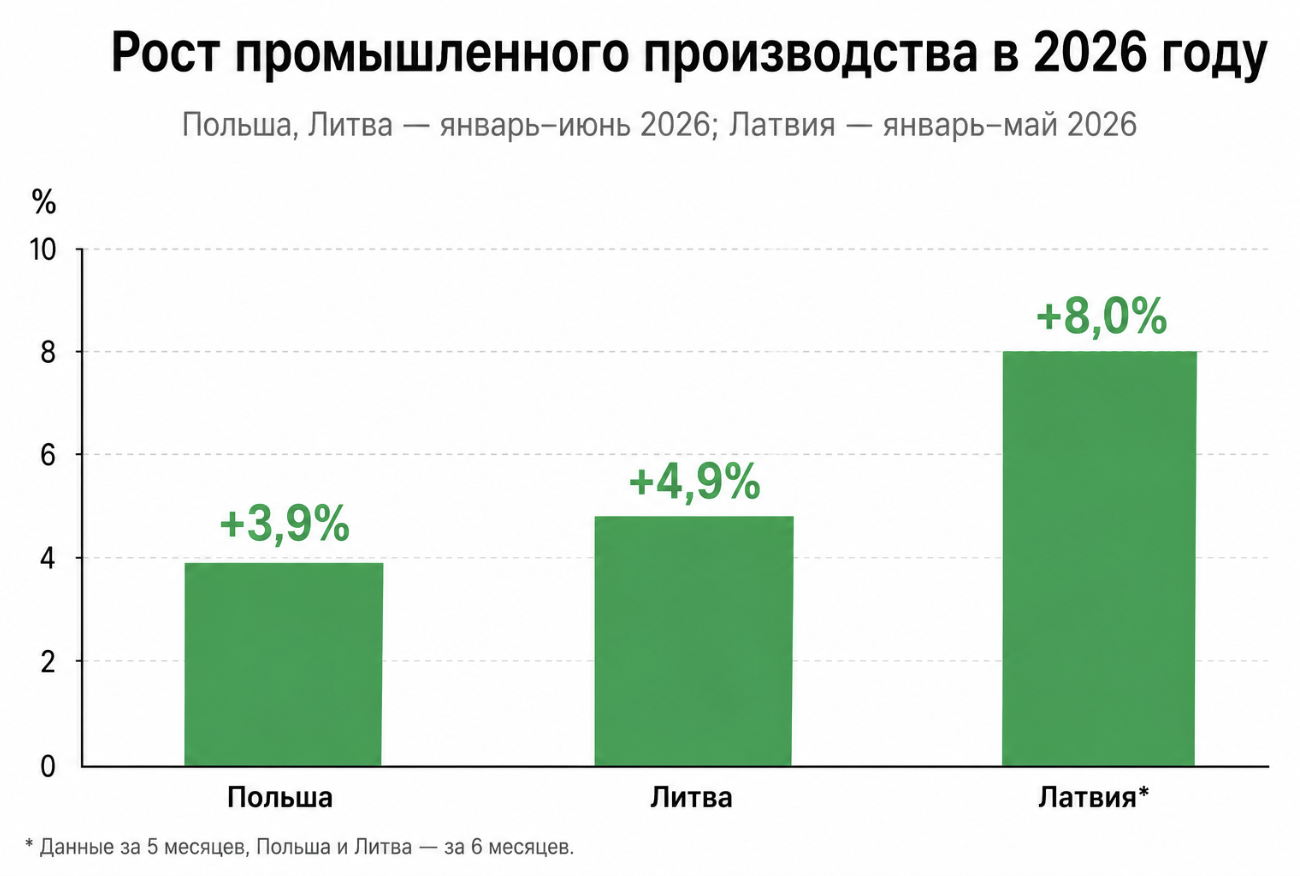
Industrial Production Growth in 2026
Poland and Lithuania: January–June 2026; Latvia: January–May 2026
Source: BIC
By contrast, industrial output in Belarus remained in negative territory, though it was gradually recovering. The year-over-year decline exceeded 3% in the first quarter, but by the end of the first half of the year, it had narrowed to less than 1%.