


The investigation was prepared in cooperation with the Rabochy Rukh initiative and supported by CyberPartisans.
Does being close to Aleksandr Lukashenko guarantee special treatment? It seems so. This investigation reveals how his personal tennis coach’s company acquired land in the center of Minsk for development without going through a competitive bidding process. While the law was not violated, the Belarusian budget missed out on millions of dollars in potential benefits.
Across from the Independence Palace — the main residence and workplace of Aleksandr Lukashenko — stands the Republican Center for Olympic Training in Tennis(RCOTT). An above-ground parking lot previously occupied the space in front of the Center. However, in February 2021, the Minsk City Executive Committee decided to transfer part of the land to an investor for development. The municipality passed over a total area of 2.6 hectares. The contract stipulated the construction of tennis courts, a hotel for athletes, and a multifunctional complex. The investor’s business plan estimated a construction cost of $27.6 million.
The investor was given land to build a business center across from the Lukashenko residence along with specific social obligations. According to the contract with the RCOTT, the developer had to donate a hotel complex with a swimming pool, gym, and catering center, as well as six new hard-surface tennis courts, to the Center upon completion of the project. Additionally, the investor was to provide the Belarusian Tennis Federation and the Tennis Academy with administrative offices in a new multifunctional complex. [*] [*]
![[*]](/storage/page_blocks/April2026/125.png)
![[*]](/storage/page_blocks/April2026/29.png)
At first glance, everything looks good. The city is getting new infrastructure, and businessmen have the opportunity to profit from the new complex facilities. However, in examining the details of the land transfer, the Belarusian Investigative Center identified a potential loss of revenue for the budget of the Belarusian capital.
They could have earned 250 times as much
TAA BelGlobalGarant (a limited liability company as defined by the law of Belarus) is the investor that received the land for construction in the center of Minsk. On March 5, 2020, Aleksandr Lukashenko signed a personal directive that made the deal possible. However, the company did not acquire the land in private ownership; instead, it obtained it on a lease basis. [*] [*] [*]
![[*]](/storage/page_blocks/April2026/35.png)
![[*]](/storage/page_blocks/April2026/45.png)
![[*]](/storage/page_blocks/April2026/55.png)
In Belarus, the primary method for obtaining state-owned land for business or construction purposes is to participate in an open auction for landlease rights. The initial price of the site must be equal to or greater than its cadastral value. In the case in question, the cadastral value of the land on Peramozhtsau Avenue in Minsk was 19.6 million Belarusian rubles, which is approximately equivalent to $7.5 million. [*]
![[*]](/storage/page_blocks/April2026/65.png)
Thanks to documents provided by the Rabochy Rukh initiative, we found out how much BelGlobalGarant paid for the right to lease the land: less than 80,000 rubles (about $30,000 at the time of exchange). This is less than 1% of the land’s cadastral valuation. In other words, if the city authorities had held an open auction, the capital’s budget would have received at least 250 times as much. For instance, the site of the former trolleybus depot on Masherau Avenue in Minsk was sold at auction in 2017 for nearly five times the initial lot price.
According to Belarusian legislation, land plots can be allocated to investors without bidding.
According to the 2007 Decree of the President of the Republic of Belarus, the head of state may transfer the allotment directly to the investor by personal directive. Therefore, transferring the right to lease land in this case does not constitute a violation. The amount paid by BelGlobalGarant for the lease rights — less than 1% of the cadastral valuation — complies with current Belarusian legislation governing land transfers without an auction.
According to the business plan, the investor’s own expenses were only supposed to cover 3% of the total costs. In late 2020, Belagroprombank, a state-owned bank, opened a $26.7 million credit line for BelGlobalGarant. [*] The loan was granted through 2033 at an interest rate of 6% per year. [*] Belagroprombank received the property rights to the future complex as collateral. The contract estimated the property’s value at $22.8 million. [*]
![[*]](/storage/page_blocks/April2026/75.png)
![[*]](/storage/page_blocks/April2026/87.png)
![[*]](/storage/page_blocks/April2026/105.png)
In September 2023, BelGlobalGarant commissioned an independent assessment of the future property. The expert examination was conducted by the Minsk City Agency for State Registration and Land Cadastre (RUP Minskaye Haradskoye Ahentstva pa Dziarzhaunay Rehistratsyi I Ziamelnym Kadastry). The valuation result amounted to $69.3 million, excluding value-added tax. [*] [*]
![[*]](/storage/page_blocks/April2026/1112.png)
![[*]](/storage/page_blocks/April2026/126.png)
At the beginning of 2024, the business center at 63V Peramozhtsau Avenue was commissioned and accepted for operation. Just eight months later, in August, BelGlobalGarant tried to sell the facility. In a letter to a potential buyer, they listed the property’s advantages: the neighborhood is located next to the Palace of Independence, Flag Square, and the Republican Tennis Center. It was also noted that the project comprises three autonomous buildings totaling more than 28,000 sq. m and housing 42 comfortable Class A offices. The estimated cost of the complex and parking lots was $68.7 million, excluding VAT. [*] [*] [*] [*] The BIC does not know if any deal has been made, but the figures in the proposal illustrate the difference between BelGlobalGarant’s expenses and potential revenues.
![[*]](/storage/page_blocks/April2026/135.png)
![[*]](/storage/page_blocks/April2026/145.png)
![[*]](/storage/page_blocks/April2026/155.png)
![[*]](/storage/page_blocks/April2026/165.png)
Get in and get out
BelGlobalGarant was the brainchild of Aleksandr Lukashenko’s personal tennis coach and “wallet,” Sergei Teterin. The project to build a multifunctional business center on the site of an above-ground parking lot in front of the Center for Olympic Training in Tennis in Minsk was initiated while he was serving as head of the Belarusian Tennis Federation.
Source:
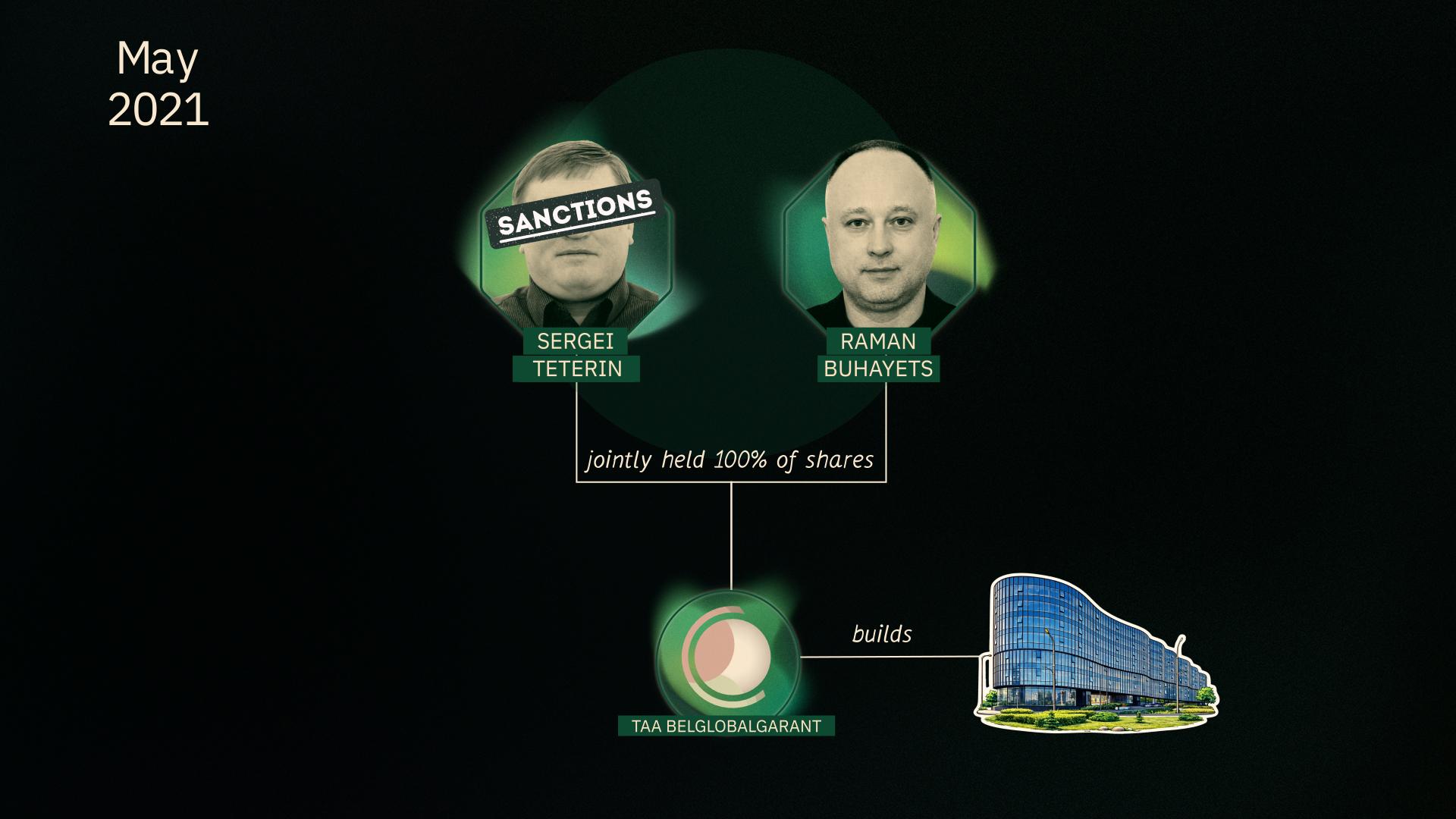
BIC / Previously, BelGlobalGarant was owned by Sergei Teterin and Raman Buhayets, a board member of the Belarusian Tennis Federation. In May 2021, one month before EU sanctions were imposed on Teterin, ownership was transferred to the Russian company "Intertreid". As of the time of publication, its owner is Nikita Morozov, a resident of Voronezh. Morozov established a board of directors in the company but did not join it himself. Instead, the former owners — Teterin and Buhayets — became members
Source:
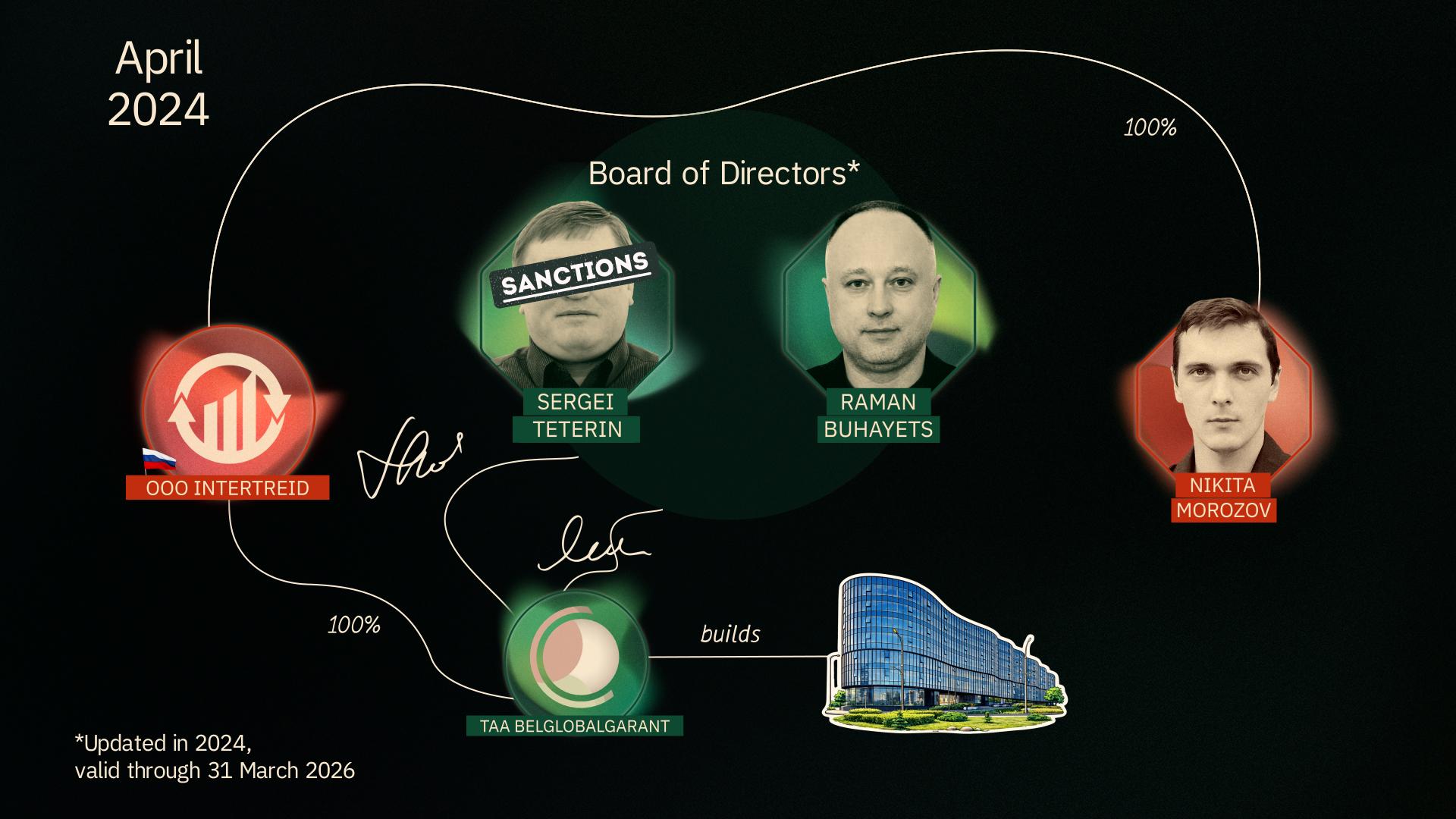
BIC / Previously, BelGlobalGarant was owned by Sergei Teterin and Raman Buhayets, a board member of the Belarusian Tennis Federation. In May 2021, one month before EU sanctions were imposed on Teterin, ownership was transferred to the Russian company "Intertreid". As of the time of publication, its owner is Nikita Morozov, a resident of Voronezh. Morozov established a board of directors in the company but did not join it himself. Instead, the former owners — Teterin and Buhayets — became members
0
/
2
In June 2021, the EU imposed personal sanctions on Teterin. He was named as a member of Lukashenko’s inner circle in the justification. A few weeks earlier, the businessman had resigned from the company, enabling BelGlobalGarant to avoid European restrictions. [*] [*] However, the company created a new management body, the board of directors, in the spring of the following year. Sergei Teterin joined the board almost immediately, thus retaining his influence on the company’s activities. [*] [*] [*]
![[*]](/storage/page_blocks/April2026/175.png)
![[*]](/storage/page_blocks/April2026/185.png)
![[*]](/storage/page_blocks/April2026/195.png)
![[*]](/storage/page_blocks/April2026/202.jpg)
![[*]](/storage/page_blocks/April2026/212.jpg)
The Belarusian authorities have repeatedly shown Teterin’s company exceptional treatment.
In one of the investigations, the BIC explained that BelGlobalGarant received the exclusive right to build special stationary disinfection stations on the Belarusian border in 2022.
The company was appointed as the operator responsible for the stage-by-stage construction and operation of the disinfection barriers, as well as for creating an electronic accounting system for mandatory payments. According to Lukashenko’s decree, BelGlobalGarant was responsible for financing the construction of all facilities and must recoup the costs by charging for vehicle disinfection at the border. Payment collection began in September 2023. BelGlobalGarant is the only private company in Belarus authorized to collect mandatory border payments for this type of activity.

Source:
president.gov.by / Sergei Teterin is in the center, wearing a red shirt. Aleksandr Lukashenko is in the foreground.
The actual cost of the “social burden”
In 2020, BelGlobalGarant estimated the value of the real estate assets it planned to transfer to the RCOTT at 9.5 million Belarusian rubles (approximately $3.5 million). The assets’ market value was at least 14 million rubles (approximately $5 million). However, the company’s actual expenses were much lower. However, the company’s actual expenses were lower. For example, the construction of the tennis courts cost about 1 million Belarusian rubles. [*] [*] [*] [*]
![[*]](/storage/page_blocks/April2026/223.png)
![[*]](/storage/page_blocks/April2026/233.png)
![[*]](/storage/page_blocks/April2026/243.png)
![[*]](/storage/page_blocks/April2026/252.png)
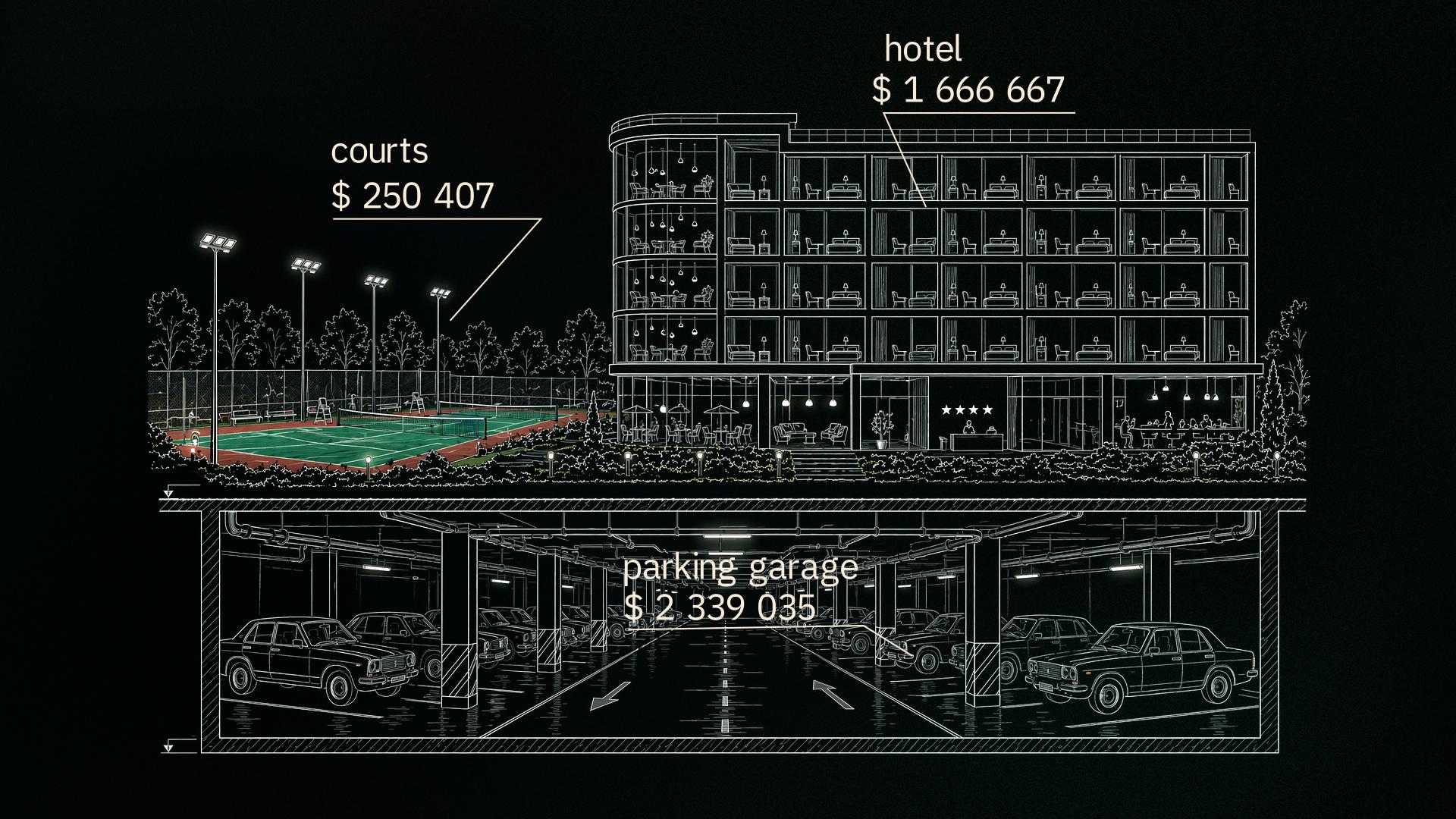
According to the business plan, 5 million Belarusian rubles were supposed to be allocated for the construction of the hotel along with the related infrastructure. However, we do not know how much the construction of the hotel ultimately cost or whether it was completed: the hotel is not listed in the commissioning certificate dated January 12, 2024. We also could not find it on the cadastral map. [*]
![[*]](/storage/page_blocks/April2026/262.png)
Source:
BIC
Even if we assume that the hotel was completed after 2024 or is still planned, the total social obligations of “BelGlobalGarant,” according to the cost estimates, amounted to 6 million Belarusian rubles, or about $2 million.
Teterin’s company also built an underground parking garage beneath the tennis courts. The documentation indicates that this is another parking lot that is not associated with the underground parking facility at the business center. In 2024, after construction was completed, BelGlobalGarant asked the Minsk City Executive Committee to divide the tennis courts and the underground parking lots beneath them into two separate properties. We do not know how the Minsk City Executive Committee responded to Teterin’s company proposal. However, according to the business plan available to the editorial team, there are no plans to transfer ownership of the underground parking to the state. [*] [*]
![[*]](/storage/page_blocks/April2026/272.png)
![[*]](/storage/page_blocks/April2026/282.png)
Lawyer Mikhail Kirilyuk evaluated the legality of the transaction described in this investigation in a comment to the BIC:
“If the law is understood as giving the president the ability to unilaterally sign documents allocating land plots in the Republic of Belarus, exclusively by the signature of one person, at any price, to any citizen… <...> this law was adopted with a serious legal defect and a corruption-related element. In other words, it creates conditions for corruption. In a normal state with a proper separation of powers, it should not have passed anti-corruption legal review.”
Who else was given land by Lukashenko?
For a long time, businesses in Belarus have been building sports facilities in exchange for access to land attractive to investors. Typically, the so-called “social burden” is imposed on investors who receive land or undertake major projects with Aleksandr Lukashenko’s approval. The BIC had previously investigated a case in which the head of state had personally allocated land in Minsk to people close to him and exempted them from paying for these plots. Such transactions result in the public purse losing tens of millions of dollars, while companies owned by businessmen or athletes close to Lukashenko receive windfall profits.
In late 2021, TAA SkiBudInvest (a limited liability company as defined by Belarusian law) undertook to build an indoor ski arena adjacent to the Dreamland amusement park and the new Supreme Court building in Minsk.
Simultaneously, the company was granted plots of land in the capital city for the construction of 115,000 square meters of apartment buildings on Vaupshasau, Zakharava, and Chyhunachnaya streets. The authorities emphasized that yet another sports complex is being built by private businesses, not at the expense of the budget.
SkiBudInvest had announced that it would invest $13 million in the ski arena. However, investigators and experts calculated that the value of the three plots of land received by the investor is $15 million. In other words, the value of the free land alone would cover SkiBudInvest’s investment in the ski arena, while still leaving the company with millions of dollars in profit from the sale of the apartments built in the capital.
Siarhei Shytkouski Jr., an ex-hockey player for the Belarus national team, owned a share in SkiBudInvest (the company was liquidated at the time of publication). Although he has completed his professional sports career, Shytkouski continues to play with Aleksandr Lukashenko on the same amateur hockey team.
When asked by the BIC about cases in which the law allows land to be given to investors without an auction, and the extent to which this is a common practice for commercial development, former businessman Aliaksandr Knyrovich answered: “This is a common phenomenon. It’s usually how they attract significant investors or implement land transfer schemes for ‘their own people’ when it comes to commercial construction.”
“Of course, it would be more profitable for the state to sell all the land at auction,” Knyrovich continues. “Roughly speaking, it would be better to sell it ‘for money’ rather than social obligations. This way, the distribution of land would be more transparent, and more money would certainly be generated.”
Other businessmen close to Lukashenko had previously used Teterin’s scheme. The Triple company of Yury Chyzh built an ice complex near the Student Village to secure the right to build the “House at Trinity Suburb.” Pavel Topuzidis’s Tytun-Invest financed the construction of an ice rink near Minsk in exchange for the right to build the Zamak shopping center.